
There’s a myth floating around that says you have to be wildly successful, crystal clear on your brand, and practically dripping with credentials before you’re crowned a thought leader.
Like there’s a secret club you’re invited to only after you’ve hit certain milestones.
But what if that’s exactly what’s holding you back, and keeping your best clients from finding you?
Chances are you have plenty to say. You’ve had client wins. You’ve spotted industry nonsense. You’ve felt the itch to speak up, but stopped yourself, believing, “Who am I to say this?”
And just like that, your boldest, best insights never see the light of day.
Here’s two pieces of good news:
1. Thought leadership isn’t about being done. It’s about being brave enough to share what you’re learning and believing out loud.
2. The right kind of help from AI can help shape those messy, brilliant ideas into confident, scroll-stopping nuggets that build your brand while becoming the expert you’re meant to be.
And here are three ways to make that happen:
1. Use AI to Angle Your Opinions into Share-Worthy Hooks
.
Every expert has opinions. What most are missing is the fresh angle that makes it stand out. Why not use AI to help uncover it?
Start by feeding your AI a simple statement you believe, then ask it to pump up the volume by:
Making it more contrarian.
Adding emotional juice.
Reframing it so even a jaded follower takes note.
AI will uncover sharper angles, more provocative phrasing, and emotionally charged variations that instantly sound like the you with something to say.
Instead of waiting til it’s all perfect, experiment out loud.
Use ChatGPT to draft 5–10 ways to frame a belief or point of view, then test which ones spark the most engagement.
This also helps solve your “what do I post about?” problem by giving you scores of fresh angles to message your core ideas.
The fastest path to thought leadership is having the courage to explore strong points of view in public before you have all the answers.
2. Have AI turn your Mild Takes into Mic-Drop Truth Bombs
.
A lot of entrepreneurs hold back their real opinions because they don’t want to offend or sound arrogant. The result? Lukewarm content that does nothing to showcase your raw talent.
Instead, overcome your hesitation using AI to dial things up without sounding like a jerk. Just take a sentence, passage or point of view from something you’ve already put out there and use this prompt:
Act as a masterful messaging mentor with a special skill amping up the energy, focus and edge for entrepreneurs hesitant to become full-fledged thought leaders.
.
I would like you to take the following passage, which feels a bit generic and low voltage, and sharpen it, so it expresses a strong clear point of view without being obnoxious or offensive. I’m ready to start showing up with more of an edge but struggling with the language that allows me to make more of a splash.
.
Please inject confidence, or even add a layer of humor or edge that makes the idea more memorable.
.
Here is the copy in question: [ PASTE COPY HERE ].
.
If you have any questions about it, please ask so I can clarify.
.
If not, go ahead and give me 5 options for higher impact positioning that’s clear, fresh, on-target, with a strong point of view.
This isn’t about pretending to be someone you’re not. It’s about amplifying the bolder version of you that already exists, but gets buried under a fear of being seen or heard.
3. Mine the gold in Your Voice Notes & Client Calls
.
If you’re a talker (not a writer) your best ideas come when you’re chatting with a client, venting in Voxer, or riffing on a call. Use AI to turn raw voice content into structured, powerful thought leadership pieces.
Instead of forcing yourself to write, let AI sculpt your spoken brilliance into razor sharp content that sounds polished AND uniquely you.
Record your riff, transcribe it, and then drop it into ChatGPT with a prompt like this:
I’m going to give you a rough, unedited transcript or raw text pulled from a voice note or client call. I want you to help me turn this into a scroll-stopping piece of thought leadership content.
.
Before you jump in, here’s a few details:
.
My Target Market:
[ insert who this is for — e.g., “coaches and consultants working toward their first $100K year” ]
.
The Outcome I Specialize In:
[ insert the main transformation/result you help people achieve — e.g., “enrolling more clients with seductive offers and magnetic messaging” ]
.
Specific Issue Addressed in This Segment:
[ insert the problem or misconception being tackled — e.g., “they think they need a fancy website before they can start making sales” ]
.
Primary Point I Want to Convey:
[ insert the main insight or reframed belief — e.g., “You can make 6 figures with a Google Doc and a payment link if your offer and message are dialed in.”]
.
Your role:
.
Extract the core idea and shape it into a clear, confident piece of thought leadership (could be a short-form post, micro-essay, blog intro, or mini-article).
.
Keep my tone conversational, confident, and slightly edgy — like I’m sharing a hard-won truth with a friend over coffee.
.
Highlight the tension between what people think they need vs. what actually works.
.
Add rhythm, pacing, and wordplay if it fits — but never at the expense of clarity.
.
Avoid sounding like a news anchor or polished thought bot. Let it feel real but smart.
.
Please also give me:
.
A strong, scroll-stopping headline or hook for this idea
.
A call-to-action or final line that invites engagement, shares a next step, or leaves a punchy thought
And finally: Always maintain confidentiality! If your voice transcript is from a client call, remove ALL personally identifiable information from which people could identify the client. And ensure it addresses a common issue many in your audience are dealing with.
You don’t need a book deal, a TEDx talk, or a six-figure funnel to be a thought leader.
You just need a fresh perspective, and the conviction to put it out there. These three avenues get you started using AI to sharpens your ideas, polish your voice, and say what you really mean.
It’s not about being perfect. It’s about being powerful.
Your next client isn’t looking for someone who has it all figured out. They’re looking for someone who sees the world like they do, and a point of view that expresses that.
When you start showing up with clarity, confidence, and even a little edge, people notice. They get it. And more importantly, they trust.
If you’ve been holding back, waiting til your message feels “ready”, consider this your reminder its go time. Use the tools. Trust your voice.
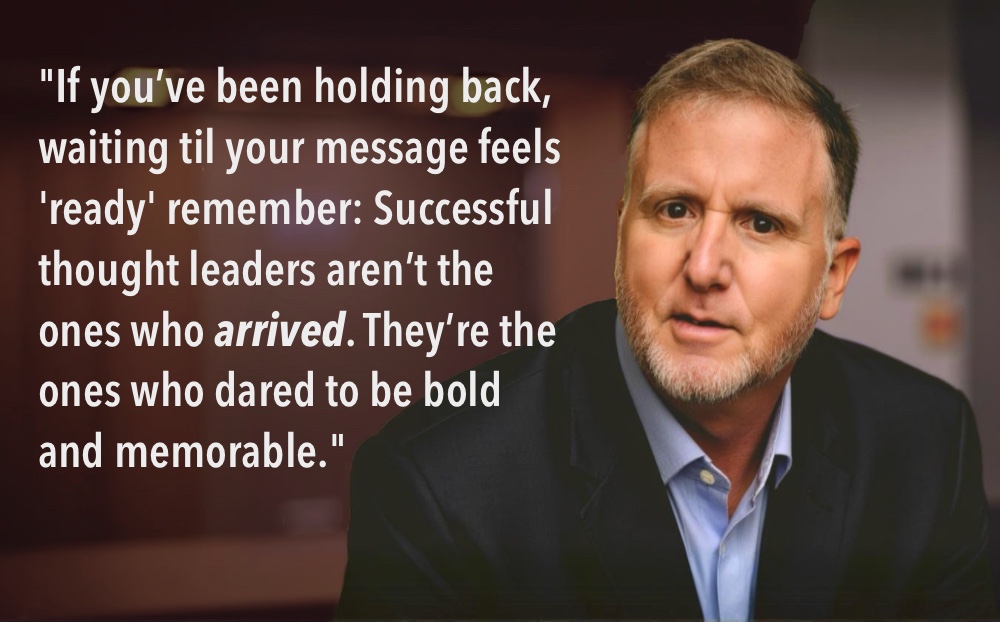
And remember: Successful thought leaders aren’t the ones who arrived. They’re the ones who dared to be bold and memorable.